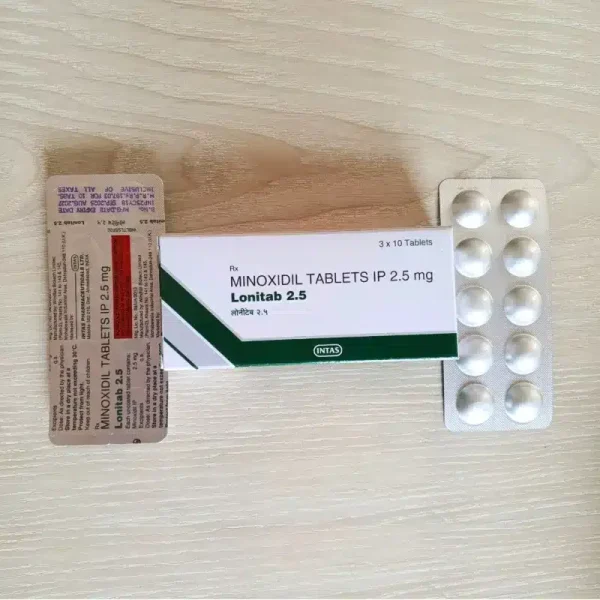
Lonitab 2.5 (Oral Minoxidil) in Bangladesh: Price, Mechanism, Dosing, and a Complete Safe-Use Guide
Before you read further: oral minoxidil is a systemic medication with real cardiovascular effects, not a cosmetic supplement. This guide is general information to support a conversation with a doctor or dermatologist, not a replacement for one. Starting dose, monitoring, and any adjustments should be set by a prescriber rather than chosen independently.
Hair loss is one of the most heavily researched areas of dermatology, and few treatments have shifted as quickly in recent years as oral minoxidil. If you’ve been comparing low-dose oral minoxidil tablets like Lonitab, or weighing it against a topical formulation you may have already tried, this guide walks through how the medication works biologically, how the 2.5 mg dose is typically used compared with the 5 mg version, what current pricing looks like, and what medically supervised use should involve in practice. Current pricing and stock are listed on the oral minoxidil product listing, where Lonitab 2.5 is available at 350 BDT.
What Is Lonitab 2.5?
Lonitab is a brand of oral minoxidil, most often prescribed off-label for androgenetic alopecia (pattern hair loss) in both men and women. Most people first encounter minoxidil as a topical foam or liquid applied directly to the scalp, but the tablet form is swallowed and works through the bloodstream rather than the skin.
Minoxidil wasn’t originally developed as a hair-loss treatment. It was developed to treat severe, treatment-resistant hypertension, and it remains FDA-approved in oral form only for that indication, under the brand name Loniten, as confirmed in its official prescribing label on the NIH’s DailyMed database. A detailed pharmacological overview from NCBI’s StatPearls resource explains that the drug works by opening ATP-sensitive potassium channels in blood vessel walls, producing vasodilation. While minoxidil was being used at much higher doses to manage blood pressure, physicians observed increased hair growth as a side effect — a phenomenon known clinically as hypertrichosis — which eventually led researchers to repurpose it for hair loss, first topically and later, in far lower doses, as an oral tablet.
It’s worth being clear about what “off-label” means here. It doesn’t mean unsafe or unstudied — it means the medication is being prescribed for a purpose other than the one it was originally approved for. Oral minoxidil for hair loss now has a substantial and growing evidence base, even though the tablet itself wasn’t brought to market with hair loss as its intended use. Shoppers can browse the full range of oral minoxidil strengths currently available to see how Lonitab fits alongside other options.
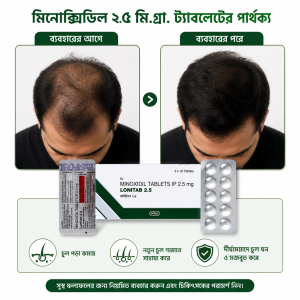
The Science: Vasodilation, the Hair Growth Cycle, and Sulfotransferase Activation
To understand why minoxidil helps some people more than others, it helps to understand the hair growth cycle itself. Every follicle moves through three phases: growth (anagen), a short transitional phase (catagen), and rest (telogen), after which the hair sheds and a new cycle begins. In androgenetic alopecia, this cycle becomes progressively disrupted — follicles spend less time in anagen and more time resting, and each new hair is thinner and shorter than the one before it.
Minoxidil is believed to intervene in two connected ways: by prolonging the anagen phase, and by improving blood flow to the follicle, increasing the oxygen and nutrients available for active growth. For topical minoxidil specifically, effectiveness depends heavily on an enzyme called sulfotransferase (SULT1A1), which converts minoxidil into its active form, minoxidil sulfate, at the follicle itself. Research on sulfotransferase enzyme activity as a predictor of minoxidil response found that this enzyme’s activity varies significantly from person to person — a major reason two people can apply topical minoxidil with identical consistency and see very different results.
This variability is one of the central reasons oral minoxidil has become a meaningful option for people who don’t respond adequately to the topical form. Because the tablet is absorbed systemically and processed by the liver rather than depending solely on local scalp enzyme activity, it can work for some individuals even when topical minoxidil hasn’t — though follicular activation still plays some role in oral minoxidil’s effectiveness too, so it isn’t a complete workaround of the underlying biology.
Androgenetic Alopecia vs. Telogen Effluvium: Confirming What You’re Actually Treating
Minoxidil, oral or topical, is specifically studied for androgenetic alopecia — the gradual, pattern-based thinning driven largely by genetics and hormone sensitivity at the follicle. It’s worth distinguishing this clearly from telogen effluvium, a different and often temporary form of hair shedding that can look similar at a glance but has a different cause and a different treatment path.
Telogen effluvium happens when a stressor — illness, significant weight change, childbirth, high fever, major surgery, or a period of intense psychological stress — pushes an unusually large number of follicles into the resting (telogen) phase at once. The result is diffuse shedding across the whole scalp, typically noticed two to three months after the triggering event, rather than the more localized crown or hairline thinning pattern seen in androgenetic alopecia. Telogen effluvium often resolves on its own within six to nine months once the underlying trigger is addressed, and doesn’t necessarily require long-term minoxidil treatment the way androgenetic alopecia does.
This distinction matters practically: someone experiencing telogen effluvium who starts oral minoxidil may see their hair recover regardless, simply because the underlying trigger resolved — which can create a misleading impression of what the medication actually did. A proper evaluation, ideally including a scalp examination and a history of recent triggers, is the most reliable way to confirm which condition is actually driving the hair loss before committing to months of a systemic medication.
Why Some People Choose the Oral Tablet Over Topical Minoxidil
- No mess, residue, or scalp irritation from the vehicle. Topical minoxidil solutions are applied twice daily and often contain a propylene glycol or alcohol-based carrier that can leave hair greasy or trigger contact dermatitis in sensitive users. Because the tablet is swallowed, none of that applies.
- Coverage that doesn’t depend on application technique. Topical minoxidil only affects the areas it physically touches, and even, consistent application across a thinning area can be harder in practice than it sounds. Oral minoxidil isn’t limited in the same way.
- Less dependent on an enzyme that varies person to person, as covered above — though not entirely independent of it.
- A simpler daily routine. One tablet once a day replaces a twice-daily application ritual that some people find difficult to sustain over the many months minoxidil requires to show results. Since inconsistent use is one of the most common reasons topical minoxidil appears “not to work,” the simplicity of a tablet can itself improve real-world outcomes.
None of this makes oral minoxidil automatically the better choice — it comes with a more systemic side-effect profile, covered in detail below, and that trade-off is exactly why the decision belongs in a conversation with a prescriber rather than being made on convenience alone.
Oral vs. Topical Minoxidil: A Direct Comparison
Topical minoxidil, sold under formulations like the Tinfal 10 Minoxidil Topical Solution, remains the only form of minoxidil with direct FDA approval for androgenetic alopecia, as confirmed in a comprehensive clinical review of minoxidil published on PubMed. Oral minoxidil, by contrast, is used off-label but has built a substantial evidence base over the past decade of clinical use.
| Factor | Topical Minoxidil | Oral Minoxidil (e.g. Lonitab 2.5) |
|---|---|---|
| Regulatory status | FDA-approved for androgenetic alopecia | Off-label, dermatologist-directed |
| Application | Twice daily, applied directly to the scalp | Once daily tablet, taken by mouth |
| Dependent on scalp enzyme activity | Yes — closely tied to SULT1A1 activity | Less dependent, though follicular activation still plays a role |
| Typical side effects | Scalp irritation, dryness, contact dermatitis | Hypertrichosis, fluid retention, palpitations |
| Systemic cardiovascular risk | Minimal, due to localized application | Present, requires prescriber monitoring |
A randomized clinical trial comparing the two approaches found that 5 mg oral minoxidil produced efficacy broadly comparable to twice-daily topical minoxidil 5% over 24 weeks in men with androgenetic alopecia, though it didn’t demonstrate clear superiority for either form. In practice, the choice often comes down to tolerability, lifestyle fit, and individual response rather than one form being universally more effective. According to a patient guide published by the International Society of Hair Restoration Surgery, oral minoxidil tends to produce somewhat stronger results than the topical form for many patients, though side effects like dizziness, tachycardia, and increased facial or body hair are also more pronounced.
Some prescribers combine both approaches under close supervision — for example, using a formulation such as the Morr-F 5 Minoxidil and Finasteride Lipid Solution, which pairs topical minoxidil with a DHT-inhibiting agent to address two different mechanisms of hair loss at once. Combining oral and topical forms increases total systemic exposure, though, and should only be done if specifically directed by a dermatologist.
Lonitab 2.5 mg vs. 5 mg: How Dosing Decisions Are Made
Dosing for hair loss is individualized rather than fixed, and this is one of the areas where self-directed use carries the most risk. A 2024 review of hair follicle sulfotransferase activity and oral minoxidil effectiveness notes that studied oral doses generally range from 0.25–2.5 mg daily for women and 1.25–5 mg daily for men, aiming to balance follicular benefit against systemic side effects. A systematic review and meta-regression analysis of low-dose oral minoxidil also found a positive dose-dependent relationship between dose and efficacy — but the same relationship holds for side-effect risk. Higher doses tend to work somewhat better on average, but they also increase the likelihood of fluid retention, palpitations, and unwanted hair growth elsewhere on the body, which is precisely why starting dose and any later adjustments should be determined by a prescriber weighing personal risk factors rather than self-selected.
| 2.5 mg | 5 mg | |
|---|---|---|
| Typical role | Common starting point for most new users, prescriber-directed | Sometimes used for more resistant cases, under closer monitoring |
| Side-effect likelihood | Lower | Higher, particularly fluid retention and tachycardia |
| Adjustment pattern | May be increased if response is insufficient after several months | May be reduced, sometimes to a fraction of a tablet, if side effects appear |
Safety Profile: What the Research Shows
Because oral minoxidil is absorbed systemically, it carries a meaningfully different risk profile than the topical form. A pooled analysis of individual patient safety data across 442 patients found hypertrichosis in roughly a quarter of users and lower-limb edema in about 2%, with both effects more common at higher doses. Encouragingly, a retrospective study evaluating blood pressure changes with low-dose oral minoxidil found no clinically significant blood pressure effects at the doses typically used for hair loss — though individual monitoring, including baseline blood pressure and heart rate checks before starting, is still recommended given the drug’s underlying cardiovascular mechanism. A single study shouldn’t be read as a blanket safety guarantee; individual risk factors vary, which is exactly what a prescriber is positioned to evaluate.
- Hypertrichosis: increased hair growth beyond the scalp, most often on the face, forearms, or back — reported more frequently in women and at higher doses.
- Fluid retention: mild swelling, typically localized to the lower legs and ankles, usually appearing within the first few months of treatment.
- Heart rate changes: palpitations or a noticeably faster resting heart rate, related to the drug’s vasodilatory effect.
- Lightheadedness: most noticeable when standing up quickly, particularly during the early weeks of treatment.
Seek medical attention promptly — rather than waiting to see if symptoms pass — if you experience chest pain, a persistent rapid or irregular heartbeat, significant swelling, or fainting.
Who Should Be Cautious, or Avoid It Entirely
- Anyone with a history of heart disease, arrhythmia, or significantly low blood pressure
- Anyone with kidney disease, since minoxidil clearance can be affected by reduced kidney function
- Pregnant or breastfeeding individuals
- Anyone currently taking other medications affecting blood pressure or fluid balance, without first discussing possible interactions with a prescriber
- Women considering it for pattern hair loss, who are typically started at a meaningfully lower dose than men — one that should be prescribed specifically, not approximated by splitting a standard tablet
What to Expect: A Realistic Timeline
Most clinical evidence points to a minimum of three to six months of consistent daily use before meaningful density changes become visible. Research on the clinical utility of minoxidil response testing notes that a visible response is typically observed only after this window, which is why dermatologists consistently caution against judging effectiveness too early.
An initial shedding phase in the first few weeks is common, and is generally interpreted as dormant follicles entering a new growth cycle rather than a sign the treatment isn’t working. If treatment is discontinued, the underlying miniaturization process typically resumes, and gains made during treatment are usually lost gradually over the following months as follicles return toward their prior state. This makes oral minoxidil a long-term commitment rather than a short course with permanent results.
Monitoring: What Ongoing Medical Supervision Typically Involves
“Start under medical guidance” is easy to say and less obvious in practice, so it’s worth being specific about what that supervision typically involves throughout treatment, not just at the first appointment. Before starting, a prescriber will usually want a baseline sense of your cardiovascular health, including a blood pressure and heart rate check and a review of personal and family history for heart disease, arrhythmia, or kidney problems.
Once treatment begins, follow-up isn’t a one-time event. Many prescribers want a check-in within the first month or two to assess early tolerance, since fluid retention, palpitations, or lightheadedness tend to appear relatively early when they occur. Periodic follow-up over the following months then allows for dose adjustments based on both effectiveness and tolerability, and gives you a structured opportunity to raise anything that’s changed.
This ongoing relationship is one of the more meaningful differences between oral and topical minoxidil in practice. Because topical minoxidil’s risks are largely localized to the scalp, it doesn’t usually require this level of structured follow-up — oral minoxidil’s systemic nature is exactly why it does.
Interactions With Other Hair Loss Treatments
Oral minoxidil is often discussed alongside other hair loss treatments, and it’s worth understanding how it fits alongside them rather than in isolation. Minoxidil addresses a different part of the underlying process than DHT-inhibiting treatments like finasteride: minoxidil works primarily through vasodilation and extension of the anagen phase, while finasteride reduces the conversion of testosterone into dihydrotestosterone (DHT), the hormone most closely linked to follicle miniaturization in genetically susceptible hair.
Because they act through different mechanisms, some dermatologists prescribe the two together. A topical option like the Tinfal 5F Minoxidil Topical Solution pairs well with an oral finasteride regimen under a prescriber’s direction, though combining treatments generally means combining side-effect profiles as well — not just combining benefits — which is worth discussing directly rather than assuming more treatments simply means proportionally more benefit with no added downside.
Common Misconceptions Worth Addressing
A few misunderstandings come up repeatedly in discussions of oral minoxidil, and addressing them directly tends to set more realistic expectations than leaving them unspoken.
“Oral minoxidil works faster than topical.” There’s no strong evidence that the oral form produces visible results meaningfully faster than the topical form — both generally require several months of consistent use. The oral form’s advantages tend to be around consistency of use and whole-scalp coverage, not speed.
“A higher dose always means better results.” As covered above, efficacy does tend to scale with dose, but so does side-effect risk. Beyond a certain point, the added benefit of a higher dose may not be worth the added risk for a given individual — a judgment call a prescriber is better positioned to make than a general dosing chart.
“Because it’s easy to purchase online, it doesn’t need medical supervision.” Availability and medical necessity are separate questions. Being able to buy a product doesn’t change the fact that it’s a systemic cardiovascular medication, and treating the two as equivalent is one of the more common — and more consequential — assumptions people make with oral minoxidil specifically.
Counterfeit and Substandard Medication: Why Sourcing Matters
Counterfeit and substandard medication is a documented concern across pharmaceutical markets generally, and hair-loss treatments aren’t exempt. Because minoxidil is often purchased without a formal prescription requirement in many markets, buyers may be more inclined to shop on price alone — which is exactly the kind of category counterfeit sellers tend to target.
The practical risk isn’t limited to a product simply “not working.” A counterfeit or improperly stored tablet may contain an incorrect dose, degraded active ingredient, or in rarer cases, an entirely different substance — a meaningfully different risk for a systemic cardiovascular medication than for a counterfeit cosmetic product. A few practical signs worth checking regardless of where you buy:
- Packaging that’s intact, properly sealed, and free of visible damage or tampering
- A visible batch number and expiry date that are legible and consistent with the packaging
- A seller willing to confirm sourcing and storage conditions rather than being vague about where stock comes from
- Pricing in a reasonable range relative to other verified sellers — a price dramatically below the norm is a reason for more scrutiny, not less
This is also a reason to be cautious about splitting or adjusting doses using tablets from unverified sources, since an inaccurate dose becomes a compounding risk on top of the product’s identity and purity.
Lifestyle Factors Worth Understanding Alongside Treatment
Minoxidil, oral or topical, addresses the biological mechanisms of hair thinning directly, but it doesn’t exist in isolation from broader health factors that can influence hair growth and overall treatment response.
Nutritional deficiencies — particularly in iron, vitamin D, and protein intake — can contribute to hair thinning independent of androgenetic alopecia, and addressing them doesn’t require minoxidil to see some improvement. This is worth raising with a doctor if hair loss has been sudden or accompanied by other symptoms, since it may point toward telogen effluvium or another cause that minoxidil alone won’t resolve. Chronic stress is another common trigger for the temporary shedding pattern described above, and generally resolves once the underlying stressor is addressed rather than requiring long-term minoxidil use.
None of this is a reason to avoid minoxidil if pattern hair loss is confirmed as the underlying cause — it’s simply a reminder that a prescriber evaluating hair loss is typically looking at the full picture, not recommending a treatment in isolation. This is another reason a proper consultation, rather than a self-diagnosis based on general symptoms, tends to produce better outcomes than starting treatment without that context.
Price and What You’re Actually Paying For
At 350 BDT, Lonitab 2.5 is priced competitively for the Bangladesh market. But price alone doesn’t tell the full story, and it shouldn’t be the deciding factor in where you source a systemic medication from:
- Verified sourcing. Sealed, authentic product matters considerably given how common counterfeit and substandard medication is in this category. An unusually low price from an unverified seller is a reason for more scrutiny, not less.
- Consistent stock availability. Because minoxidil’s benefits depend on months of uninterrupted use, a supplier that can maintain stock reliably matters almost as much as authenticity — restarting and stopping treatment due to availability gaps can undercut the results you’d otherwise see.
- Delivery reliability. Fast, dependable delivery across Dhaka and other major districts reduces the odds of a gap in your supply.
Put simply: the lowest listed price isn’t necessarily the best value if it comes with uncertainty about authenticity or supply consistency, particularly for a medication taken daily over many months.
How Lonitab Compares to Other Oral Minoxidil Brands
Lonitab is one of several oral minoxidil brands available in Bangladesh, and a reasonable question is what, if anything, differentiates one brand from another when the active compound — minoxidil — is fundamentally the same across all of them.
In practice, differences between brands of the same generic compound tend to come down to a few factors rather than the drug’s core mechanism: manufacturing quality and consistency, tablet formulation, which can affect how reliably the dose is absorbed, pricing, and the reliability of the specific supply chain a given seller uses. For a systemic medication taken daily over many months, consistency of manufacturing and supply tends to matter more in practice than small formulation differences between brands — another argument for prioritizing verified sourcing over chasing the single lowest listed price across every available option.
A prescriber may have a specific brand preference based on clinical experience, and it’s reasonable to ask about that directly rather than assuming all available options are functionally interchangeable from a sourcing-quality standpoint, even when the active ingredient and dose are the same on paper.
Building a Realistic Treatment Plan With Your Prescriber
A well-structured plan for starting oral minoxidil typically covers more ground than just the tablet itself, and knowing what to bring to that first conversation can make the consultation considerably more useful.
- A clear history of the hair loss pattern — when it started, whether it’s been gradual or sudden, whether it follows a family pattern, and whether it’s localized (crown, hairline) or diffuse across the scalp. This helps distinguish androgenetic alopecia from telogen effluvium or other causes, as covered above.
- A full list of current medications and supplements, since minoxidil’s interactions with other blood-pressure-affecting or fluid-retaining medications are one of the more important safety checks a prescriber will want to run.
- Any personal or family cardiovascular history, including arrhythmia, low blood pressure, or heart disease, which directly informs whether oral minoxidil is appropriate and at what starting dose.
- Realistic expectations about the timeline — going in expecting results within the first month, rather than the three-to-six-month window supported by the evidence, is one of the more common reasons people discontinue prematurely.
From there, a prescriber will typically set a starting dose, schedule an early follow-up to assess tolerance, and outline what symptoms should prompt an earlier check-in rather than waiting for the next scheduled visit.
How to Order Lonitab 2.5 in Bangladesh
For those who have already discussed oral minoxidil with a doctor or dermatologist and are ready to proceed, the general process is straightforward:
- Visit the current Lonitab listing on the site’s homepage and confirm pricing and stock availability.
- Select an appropriate supply size — many people on a doctor-directed regimen choose a multi-month quantity to avoid gaps in treatment.
- Enter delivery details at checkout; delivery is available across Dhaka and other major districts nationwide.
- Continue any monitoring your prescriber has recommended throughout the course of treatment, not just at the outset.
Frequently Asked Questions
Is Lonitab 2.5 the same as topical minoxidil?
No. Both contain the same active compound, minoxidil, but the oral tablet is absorbed systemically through the bloodstream rather than applied to the scalp, which changes both its effectiveness profile and its side-effect considerations.
Can women use Lonitab 2.5?
Yes, typically under a prescriber’s guidance and at a lower dose than what’s commonly used for men, given the higher reported rate of hypertrichosis in women at higher doses.
How long before results appear?
Generally three to six months of consistent daily use, often preceded by a temporary shedding phase in the first few weeks.
What happens if treatment stops?
Hair gained during treatment is typically lost gradually over the following months, since minoxidil manages the underlying process of follicle miniaturization rather than curing it outright.
Can oral and topical minoxidil be combined?
Only if specifically directed by a dermatologist, since combining the two forms increases total systemic exposure and, with it, the risk of the side effects associated with the oral form.
What kind of monitoring should I expect while taking it?
Typically a baseline blood pressure and heart rate check before starting, followed by periodic follow-up — often within the first one to two months, then at intervals afterward — to assess tolerance and adjust the dose if needed.
Where can I buy Lonitab 2.5 in Bangladesh?
Lonitab 2.5 is available at the site’s oral minoxidil category page, with delivery across Dhaka and other major districts.
Does oral minoxidil work faster than the topical version?
No strong evidence supports that. Both forms generally require several months of consistent use before visible results appear; the oral tablet’s main practical advantage tends to be ease of consistent use rather than speed.
How is androgenetic alopecia different from telogen effluvium?
Androgenetic alopecia is a gradual, pattern-based thinning driven largely by genetics and hormone sensitivity, typically localized to the crown or hairline. Telogen effluvium is diffuse shedding across the whole scalp triggered by a stressor such as illness, major surgery, or significant psychological stress, and often resolves on its own once the trigger passes. Confirming which one is actually occurring is an important first step before committing to months of minoxidil treatment.
Is the lowest price the most important factor when buying oral minoxidil?
Not on its own. Verified authenticity and consistent stock availability matter significantly for a medication meant to be taken daily over many months — an unusually low price from an unfamiliar seller is worth extra scrutiny rather than treating it as a straightforward bargain.
Can Lonitab 2.5 be split for a lower dose?
Only under a prescriber’s specific direction. Splitting tablets without guidance risks an inaccurate dose, which is a particular concern for women, who are typically started at meaningfully lower doses than men.
Final Thoughts
Oral minoxidil has become a meaningful option for people who haven’t responded well to topical treatment, or who simply prefer the convenience of a once-daily tablet over a twice-daily application routine. But its systemic mechanism means it carries a different, and in some respects more serious, risk profile than the topical form — one that deserves genuine consideration rather than being treated as a minor detail. Lonitab 2.5, available through Minoxidil.com.bd, offers accessible pricing for this treatment in Bangladesh, but the most important step in using it safely and effectively isn’t finding the lowest price — it’s starting under the guidance of a doctor or dermatologist who can confirm it’s appropriate for you, set the right starting dose, and monitor your response over the months that follow.